World War I
Doctor ZhivagoWorld War I is a force of continuous disruption in the novel: it reverses military fortunes, overwhelms hospitals, displaces civilians, and reaches into the household as shortages and uncertain political news. Its effects are shown at several scales, from a retreat in Galicia and an artillery attack to an exchange of firewood for a mirror wardrobe. Rather than remaining a distant historical backdrop, the war alters work, travel, family life, and the characters’ sense of what can be endured or judged.
Military reversals and the moving front
In the second autumn of the war, the early Russian successes have given way to reverses. Brusilov's Eighth Army, assembled in the Carpathians with the prospect of advancing into Hungary, is instead drawn into the general retreat, while Russian forces evacuate Galicia, territory occupied in the opening months of the fighting. The military map changes direction: plans for an advance become a withdrawal, and that reversal sets the conditions for the pressure on hospitals and civilians that follows.
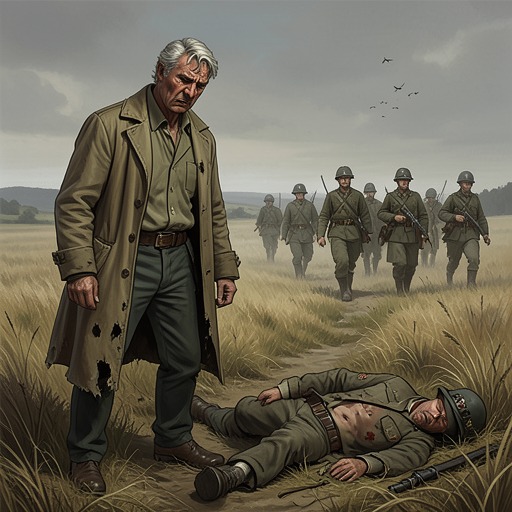
At the front, an attack appears to those watching through field glasses as a coordinated movement across an autumn field, but for the soldiers advancing it is a perilous distance under fire. Pavel Antipov leads his men forward, waving his revolver and urging them on; the attackers run, take cover, and rise again as some fall and do not get back up. When the artillery barrage stops, the observers hear the sudden silence, then two heavy German shells burst ahead of the unit. Smoke obscures what happens next, and Osip Galiullin believes Antipov and his men have been killed. The report of Antipov's death proves false: his platoon surrenders, and he is taken prisoner. The contrast between what can be seen from an observation post and what actually happens to the men reveals how easily battle produces mistaken certainty as well as casualties.
The front’s movement also makes distance and safety unstable. Misha Gordon travels from divisional headquarters toward the village where Yurii Andreievich Zhivago is serving, only to discover that the supposed fifteen-mile journey is closer to fifty. Distant artillery sounds like volcanic rumbling; at night, a glow burns over the horizon. He passes ruined villages where residents shelter in cellars and old women search the ashes of their homes. Later, when German forces break through, the village itself comes under fire, and the hospital begins moving before an evacuation order arrives. The advancing front is therefore not an abstract line: it changes the route of travel, the fate of settlements, and whether a hospital can remain where it is.
Hospitals, injury, and the work of care
The war presses directly on Yurii's medical work. While he waits outside the maternity ward where his wife, Antonina Alexandrovna Gromeko, has been admitted, a truck with two trailers brings wounded men to the hospital. Moscow’s hospitals are already desperately overcrowded, particularly after the battle of Lutsk: patients fill passages and landings, and the pressure begins to reach the women’s wards. A domestic threshold—the wait for news of his wife—shares the scene with the arrival of men injured at the front.
The same strain is visible at a mobile Red Cross first-aid station. Exhausted survivors of four days of heavy fighting lie beside the road, too depleted to react to passing carts. Ammunition carts bring in wounded men during a brief lull in the artillery fire; orderlies unload them on stretchers, and the station’s staff must bandage them quickly and operate on the most urgent cases. Many of the wounded are unconscious. The scene makes care part of the war’s logistics: medical workers must respond to a steady influx of patients, while the means of carrying them to treatment are themselves rough and improvised.
The work affects those who witness it as well as those who treat the wounded. Yurii tells Gordon that he struggles with the logic of mutual extermination and with the mutilation caused by modern fighting. Gordon, having accompanied him, recognizes the moral difficulty of watching other people face death and risk their lives; he also doubts that merely grieving for them would be more honest. When they visit the first-aid station, he discovers from experience that he can faint at the sight of wounds. The war thus tests not only medical skill but the limits of spectatorship, sympathy, and composure.
Civilian life under material pressure
The war’s effects continue beyond the immediate battlefield. In Moscow, daily food for many people consists of thin millet boiled in water, soup made from herring heads, and a second course of the herring itself; households also prepare a kind of porridge from unground wheat or rye. Antonina learns to bake bread in an improvised Dutch oven, hoping to sell some and cover the cost of heating. The bread is good, but the plan fails, and the family must return to an iron stove that smokes and gives little heat.
Scarcity turns ordinary errands into exchanges of household possessions. With only two logs left, Antonina goes out looking for fuel and finds a peasant carrying birch logs in a small sleigh. The wood is poor and too freshly cut for effective burning, but there is no practical alternative. He carries several armloads inside and takes Antonina’s small mirror wardrobe in return, intending it as a present for his bride. Their discussion of a possible future potato deal leads him to ask the price of the piano. The sequence records a household economy in which fuel, furniture, and food are linked through barter, and valuable objects become negotiable because heating the home cannot wait.
At the same time, formal channels of provision offer rare relief. Yurii and his father-in-law, Alexander Alexandrovich Gromeko, receive credit slips for goods after being asked to undertake professional work. At an old army warehouse by the Simonov Monastery, they exchange the slips for flour, cereals, macaroni, sugar, suet, soap, matches, and a wrapped portion of Caucasian cheese. They carry the provisions away in sacks, buoyed not simply by the prospect of food but by the sense that their work has made them useful. In this moment, access to provisions is both practical assistance and a measure of social purpose.
The war also reshapes transport and labor. On a twenty-three-car train carrying the Zhivagos, sailors travel at the front, civilian passengers in the middle, and about five hundred labor conscripts in eight cars at the rear. Those conscripts include lawyers and stockbrokers alongside cab drivers, floor polishers, bath attendants, Tartar ragpickers, shopkeepers, and monks. Their shared confinement makes visible a wartime reordering in which people of very different occupations and circumstances are gathered into the same system of compulsory movement.
Political unease, memory, and meaning
As the front shifts, political news from the interior becomes harder to obtain. Reports from general headquarters grow strange, alarming rumors arrive from elsewhere, and telegraphic communications with Petersburg are repeatedly cut. Politics becomes a subject of conversation at every corner. The instability is not separate from the military crisis: disrupted communications make events difficult to verify just as retreat and evacuation make daily life harder to predict.
The conflict also exposes political and social violence behind the lines. In recalling the period, Larisa Feodorovna Antipova describes beatings of Jews and an incident in which cadets ambush and shoot an instructor they accuse of Bolshevik sympathy. Her account places ideological accusation and antisemitic violence within the same unsettled wartime environment. The front’s divisions do not contain violence; political suspicion and attacks on civilians reach into towns and institutions.
For Yurii, the war’s moral consequence is not a clean conversion to one political explanation. He finds it difficult to accept mutual extermination, and the wounded he treats make the consequences of military technique immediate. His response, as conveyed to Gordon, is a struggle to comprehend rather than a claim to resolve the violence. The novel places that individual moral resistance beside the larger machinery of retreat, conscription, artillery, and evacuation, allowing the scale of events and the demands of conscience to remain in tension.
The war’s reach extends into later memory as well. A printed text of the Ninety-first Psalm, found on the young White Guardsman Seriozha Rantsevich, recalls how soldiers in the previous imperialist war wore versions of the psalm as protection against bullets. The talisman’s persistence links wartime fear to a continuing human search for protection, even as its promised safety cannot undo the reality of battle. Together with the movement of wounded men, families, and conscripts, this recurrence makes World War I more than a bounded military episode: it is an upheaval whose material and moral consequences continue to shape the world the novel depicts.